January: We are very pleased that Eamonn Dougan will direct a second course in 2026, this one for invited singers in Gourdon en Quercy in southwest France from the 30th of August to the 4th of September. Eamonn’s courses always have a large element of his outstandingly effective vocal technique coaching and there is always a dramatic improvement in the sound of the group over the week. The repertoire, all pieces for six, seven and eight voices will be taken from two publications from the 1570s: the Strasbourg Selectae Cantiones of Niklaus Wyriot and Tallis and Byrd’s Cantiones Sacrae. Pieces by Clemens, Lassus, Phinot and Crecquillon from the French collection will be set alongside Tallis’s Suscipe quaeso and Byrd’s Tribue Domine. This year’s spectacular Spem will be a hard act to follow, but this repertoire is of the finest quality and I’m sure it will be another intensely satisfying week.
Then we return to Tenby in Pembrokeshire from the 20th to the 25th of September for a week with a new Lacock director, Patrick Allies. For several years those in the know have been telling me that Patrick is a brilliant young director and we are very pleased that at last PhD deadlines and the demands of a young family have allowed him to accept the invitation. His wife is Soumaya Keynes, a former Lacock scholar on the course that Andrew Parrott directed in Trogir in Croatia, a happy connexion. Patrick’s recent research has been unearthing a major source of renaissance music, the library of the Marian Brotherhood of ’s-Hertogenbosch in the southern Netherlands, from which we will sing the pick of pieces by major composers including Manchicourt, Crecquillon, Brunel and De La Rue.
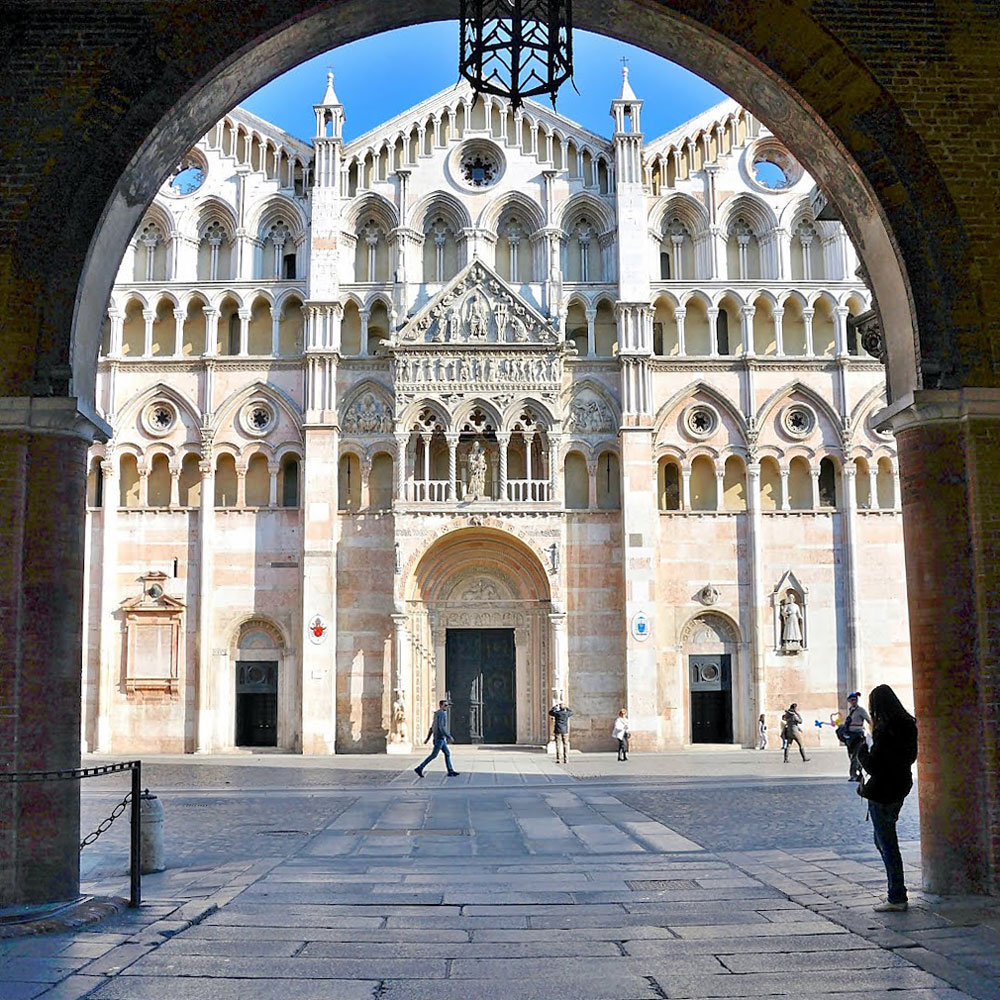
Then we will end the year with our first visit to Ferrara for a course for invited singers directed by Patrick Craig, from the 18th to the 23rd of October. We don’t know if Palestrina was born in 1525 or 1526, so his quincentennial celebrations continue. Patrick has chosen movements from two different Palestrina masses, alongside Lamentations by Victoria and two pieces by Lassus, all linked by the enormously influential patronage of Ferrara’s ruling Este dynasty, which was key to the introduction of Franco-Flemish polyphony to Italy. We have a large church in the historic centre near the cathedral and the castello, and I’m sure October will be an ideal time to visit this wonderful but often overlooked city. Ferrara cathedral is pictured at the head of this entry.
We can look back on 2025 as a vintage year – all nine courses achieving the projected number and balance of voices, some excellent new singers, interesting repertoires and three new venues all worthy of a return: Swanage, Woodbridge and the well-sited English church in Florence. Above all, we had some exhilarating music-making. Let’s hope we have mastered the trick. All the 2026 courses up to July – Cádiz, Swanage, Stirling, Monteconero and Ludlow – are full or almost so, but it’s always worth asking if you still wanted to come to one. There are odd unfilled places and, life being unpredictable, there are inevitably drop-outs for a variety of reasons.
I recently learned of the death a few years ago of Emmanuele Canevaro, Duke of Zoagli, in whose Ligurian castle we used to have courses for a few years at the beginning of the century. He was born in 1942 and outside his office I always noticed the photograph of him as a curly-haired toddler sitting on the knee of an old man, who turned out to be the composer Richard Strauss (born 1864). Emmanuele had joined The Children of God cult as a young man, and setting up each course in the small town with the communist mayor, the catholic priest and the eccentric duke, who had little in common except mutual antipathy, took all the diplomatic skills I could muster. The trick was not to let on that any arrangement was being made to accommodate either of the others. Too grand to deign to a profession, his sole source of income seemed to be letting out his spectacularly sited castle on the cliffs opposite Portofino as a wedding venue. He hated the vulgarity of the Milanese nouveaux riches who tended to be his customers and was enraptured when his halls resounded to the sound of Palestrina and Monteverdi.
Many of you will know the tenor Graham Bobby, lately of the Netherlands, New York and now Portugal, and veteran of many Lacock course. He is now not at all well. Immensely sociable and gregarious, he would I’m sure love to hear from anyone who remembers him but has lost touch. I will gladly forward any messages.