Tomás Luis de Victoria ~ Missa Gaudeamus, Lamentations, Ave maris stella
Philippe Rogier ~ Laboravi in gemitu, Regina caeli, Locutus sum
Cristóbal de Morales ~ Jubilate Deo, Regina caeli
Juan de Esquivel ~ Duo seraphim, In paradisum
Alonso Lobo ~ Tristis est anima mea
The quality of composers such as Victoria and Morales has been long known but the full extent and glory of Spanish renaissance music has only relatively recently come to light. This course explores a small sample of music by native composers and one of the many Flemish composers in the Spanish Capilla Flamenca. Philippe Rogier was born in Arras around 1561 and at the age of eleven was taken to Madrid to sing in the choir of Philip II. Like his fellow northerner Géry de Ghersem, much of his music was lost in the fire following the Lisbon earthquake of 1755. Juan de Esquivel was born in Cuidad Rodrigo around the same time and was a student of Juan Navarro. His music has interesting stylistic quirks such as chromaticism and parallel motion. Missa Gaudeamus is the young Victoria’s tribute to an illustrious predecessor, built on the ostinato on the word ‘gaudeamus’ in the Jubilate Deo that Cristóbal de Morales wrote for the Truce of Nice in 1538.
Bill Carslake composes music inspired by immersive fieldwork and maintains a busy conducting career. Compositions in 2026 include a string quartet, a set of trios, three choral works (a capella and accompanied) and a clarinet sonata. The recent large-scale orchestral composition, ‘Carrownagappul’, was commissioned by the Harry Woolhouse Trust for the 25th anniversary of Imperial College Sinfonietta and premiered in 2024. It was inspired by fieldwork on Carrownagappul bog, Ireland in collaboration with the photographer Tina Claffey.
In 2018/19 Bill won a Finzi Scholarship to compose an orchestral piece inspired by Mountain Hares. ‘Mountain Hare’ was premiered by Farnborough Symphony Orchestra in 2022. His fieldwork inspired his travel essay, ‘Composing with Hares’. The project features in the Finzi Trust podcast.
In 2016 Bill collaborated with poet Helen Mort on an exploratory climbing expedition in East Greenland for a commission from The Little Baroque Company. Their work, ‘The Singing Glacier’, was performed at festivals in London, Sheffield, Aldeburgh, Wells-next-the-Sea and Inchigeelagh. Helen’s poetry and the project feature in a chapbook of the same name published by Hercules Editions. Bill’s next large-scale fieldwork project is The Sea of Trees, involving sailing to the Faroe Islands to research birdsong and phytoplankton – the so-called ‘marine forest’.
Bill studied conducting with Martyn Brabbins at the Royal Scottish Academy of Music and Drama and with Ilya Musin in St Petersburg and Jorma Panula in Kuopio. His work as Music Director includes ‘Elizabeth’ for the Royal Ballet in 2016 and 2018. He was a bass-baritone soloist for many years and has enjoyed a fruitful relationship with Lacock Choral Courses. His first degree was in English Literature with an organ scholarship, at Pembroke College, Cambridge – and he maintains an active interest in contemporary writing.
Ludlow is one of England’s most attractive small towns, surrounded by excellent walking country. It began life as a marketplace and has in recent years reestablished a reputation for gastronomy. Proximity to the Welsh border made it an important strategic site; the young Arthur Prince of Wales, elder brother to the future Henry VIII, died in its castle in 1502. The course will take place in the magnificent mediaeval church of St Laurence, known as ‘the cathedral of the Marches’.
Click the ‘practicalities, fees & enrolment’ tab at the top of this page for further details.
The course
All the music is for SSAATB; we will aim for a group of 36, with six voices on each line. Our plan will be to meet for a 5pm session on Sunday the 5th of July. Then from Monday to Friday our timetable will be:
09.30 – 11.00 first session
11.00 – 11.30 break
11.30 – 13.00 second session
13.00 – 17.00 long break
17.00 – 19.00 third session
We will arrange a supper for everyone together on the first and last evenings (not included in the fee for the course), but let the party split into smaller groups on the other evenings. We’ll give a public performance in the evening of Friday the 10th of July.
Venue
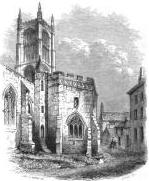
The course will be based in St Laurence’s Church, 2 College St, Ludlow SY8 1AN. The church has a magnificent tower and is unmissable on the highest point of the town.
Travel and accommodation
Ludlow is in Shropshire, about 30 miles west of Birmingham, and is on the railway line between Manchester and Cardiff, with hourly services. There is information about getting to Ludlow by car, bike, train and bus at www.theludlowguide.co.uk. The nearest international airport is Birmingham. The town has a well-organised official web site with plenty of information about the town and surrounding countryside, including a comprehensive section on places to stay at www.ludlow.org.uk.
Fees and enrolment
The fee for the course is £680, payable in two parts: a deposit of £340 or the equivalent in euros on registration and a further £340 by the 1st of June. The deposit may be credited to another course if you have to withdraw and we are able to allocate your place to another singer. The fee includes the booklet containing all the music, which will be sent to you in advance, but not accommodation, meals and travel. To apply for a place on this course, just fill in the application form below and press the ‘send application’ button.