In 1575 John Baldwin, newly appointed as a fifteen-year-old singer in the choir of St George’s Chapel Windsor, started to copy out pieces from the choir’s repertoire in his neat hand on sheets of paper with printed stave lines. 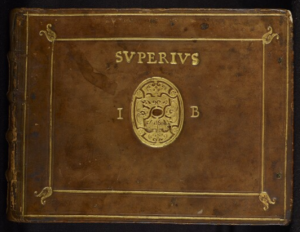 He continued to do so for 25 years, by which time he had transferred to the Chapel Royal. The Baldwin Partbooks, now held in the library of Christ Church, Oxford, comprise 170 compositions from Taverner to Byrd and are a major source for Tudor church music from not only the reign of Elizabeth (when Baldwin was copying), but also from earlier periods stretching back before the Reformation. Originally a set of six books each containing a different voice part, the tenor partbook is now missing. Some of the contents can be completed through comparison with versions of the pieces found in other manuscripts of the period, but around 60 are found uniquely in Baldwin’s partbooks. Our selection is of some of the larger-scale compositions, all with divided cantus (treble) parts.
John Sheppard ~ A solis ortus cardine
Robert White ~ Ad te levavi oculos meos, Lamentations a 6
William Mundy ~ Memor esto
Thomas Tallis ~ Videte miraculum
William Byrd ~ O quam gloriosum est regnum
Robert Parsons ~ Domine, quis habitabit
Bill Carslake writes music and words inspired by outdoor places. He collaborates with writers, artists and scientists on projects that explore our relationship with the natural world. He has a busy conducting career.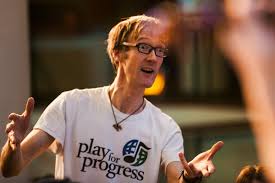 He also directs Clarity & Hart, a communications agency that works exclusively with low-carbon shipping. He has degrees in English literature from Cambridge University and orchestral conducting from the Royal Scottish Academy of Music and Drama. He has held two composing residencies at Banff Centre, Canada.
In 2018 Bill won a Finzi Scholarship to compose a piece inspired by Mountain Hares. Disco Ball – Mountain Hare (2022) was premiered by Farnborough Symphony Orchestra in last January. This piece and the extended travel essay, Disco Ball – Mountain Hare: composing in the Cairngorms feature in a Finzi Trust podcast. In 2016 he went with the poet Helen Mort on an exploratory climbing expedition in East Greenland. This inspired The Singing Glacier (2017) for baroque orchestra and spoken poetry, with film by Richard Jones. The Duel of the White-necked Ravens (2014) was inspired by watching white-necked ravens fighting mid-air above Mount Kilimanjaro. Bill was Music Director for The Royal Ballet’s Elizabeth at the Linbury Theatre (2016) and Barbican Theatre (2018). He is Music Director of Farnborough Symphony Orchestra which champions contemporary composers and hosts the FSO Young Composers Competition.
Skipton
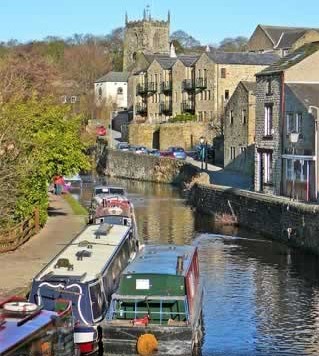
Skipton became a prosperous market town in the Middle Ages, trading sheep and woollen goods: its name derives from the Old English sceap (sheep) and tun (town or village). Skipton Castle, dating from the 12th century, is one of the most complete and best preserved mediaeval castles in England. A flourishing market held on the town’s cobbled streets on four days of the week was established by a charter of 1204. In the 19th century, Skipton emerged as a small mill town connected to major cities by the Leeds and Liverpool Canal, Britain’s longest inland waterway.
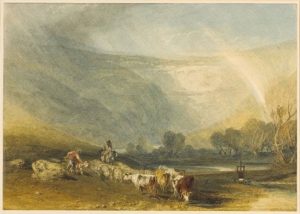
During the 20th century Skipton’s economy shifted to tourism, aided by its historic architecture and proximity to the Yorkshire Dales, classic walking country with spectacular landforms such as Malham Cove, immortalized in Turner’s 1816 painting. The network of canals, rivers, steam railways, independent high street shops and magical countryside ensure that the town regularly tops the UK’s ‘best place to live’ lists.
The course will be held in the town’s magnificent Grade I Holy Trinity church, next to the castle.
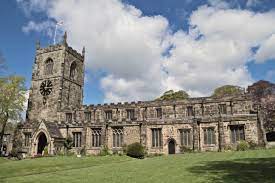
First built in wood in the 12th century, the present building dates back to about 1300 and has been declared a World Heritage site. Among its features are a mediaeval fresco representing the Hand of Death, ornate wooden carving on the 1533 rood screen, the roof of dark oak with coloured heraldic emblems, the font with its Jacobean cover and the triple sedilia in the chancel.
The course
The course is for a group of 36 singers. Our plan will be to meet for a 5pm session on Sunday the 6th of July. Then from Monday to Friday our timetable will be:
09.30 – 11.00 first session
11.00 – 11.30 break
11.30 – 13.00 second session
13.00 – 17.30 long break
17.30 – 19.30 third session
We will arrange a supper for everyone together on the last evening (not included in the fee for the course), but let the party split into smaller groups on the other evenings. We’ll give a public performance in the evening of Friday the 11th of July.
Travel and accommodation
Skipton’s station has trains from Leeds, Bradford, Morecambe, Carlisle and all connexions beyond. The nearest airport to Skipton is Leeds Bradford (LBA) which is 16 miles away. Other nearby airports include Manchester (MAN, 43 miles), Liverpool (LPL, 55 miles), Newcastle (NCL, 76 miles) and Birmingham (BHX, 105 miles). The town’ official web site (https://www.welcometoskipton.com/business-category/stay-a-while/) offers ‘somewhere for every taste and every pocket’: from hotels, B&Bs, guest houses, self-catering, traditional canal boat to shepherd’s huts.
Fees and enrolment
The fee for the course is £640, paid in two parts: a deposit of £320 (or the equivalent in euros) on registration and a further £320 by the end of May. The deposit may be credited to another course if you have to withdraw and we are able to allocate your place to another singer. The fee includes payment for the music booklet, which will be sent to you in advance, but not meals, travel or accommodation.