Alonso Lobo ~ De lamentatione Ieremiæ Prophetæ
Duarte Lobo ~ Missa pro defunctis 8 vocibus
Although they share a surname, our two composers are unrelated but both among the most distinguished in the whole field of Iberian polyphony. The Andalusian Alonso Lobo was assistant to his idol Guerrero at Seville Cathedral and went on to become maestro de capilla at Toledo. He shone as a master of polyphony imbued with the sombre intensity of the greatest Spanish composers. In his Lamentations, Lobo demonstrates his powers of expression in the long vocalizations of the Hebrew letters, moments of contemplation increasing in intensity of expression as the work progresses, and in the short bursts of concise declamation in the verses. Bruno Turner has likened the melismas at the three settings of Iod to ritual weeping in music, akin to the Spanish tradition of funerary llantas. This work is one of the finest in the whole canon of Renaissance Lamentations.
The Portuguese Duarte Lobo as mestre de capela at Lisbon Cathedral, the most prestigious musical appointment in the country. His 1621 Missa pro defunctis is in effect for a true eight-part choir, though there are some antiphonal moments between the divided ensemble. Lobo thins out his eight-part texture briefly but frequently; his harmony is very simple but very firm, with strongly directed bass lines. The general effect is homophonic, but there is some quite lively contrapuntal treatment in the Gradual and in the Offertory. The Gradual has a free-flowing trio for the verse ‘In memoria’, but elsewhere all eight voices are used. The outer movements are deceptively simple on the page yet in performance have great dignity and atmosphere.
The countertenor and director Bruno Campelo Muñíz, here making his first appearance on a Lacock course, is a rising star in Spain’s flourishing early music world. 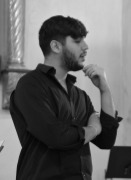 Born in Cádiz, he began his musical studies at the Joaquín Villator Conservatory in Jerez de la Frontera, and began singing in the Escolanía Juvenalia. His outstanding potential was spotted at an early age and he was invited to study singing with the countertenor Jorge Enrique García Ortega, going on to study with Romina Basso at the Conservatorio di Musica Luigi Cherubini in Florence. He now sings regularly with leading early music ensembles throughout Spain and beyond, including Altvs, Accademia del Piacere, Al Ayre Español, Virelay (the choir of Cádiz cathedral), La Real Capilla and the ensembles Sparus Aurata and Capella Prolationum. This wide experience has led him to work with directors such as Fahmi Alqhai, Eduardo López Banzo, Jean Tubéry, José Miguel Román and Fernando Pérez Valera.
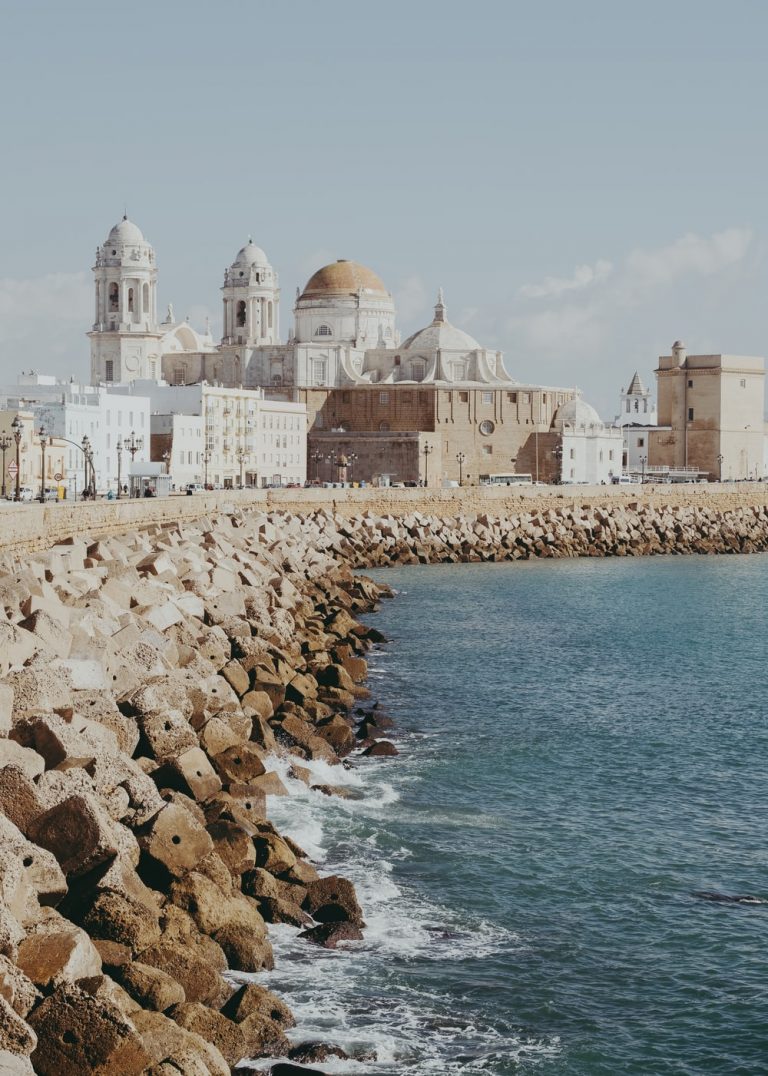
Cádiz
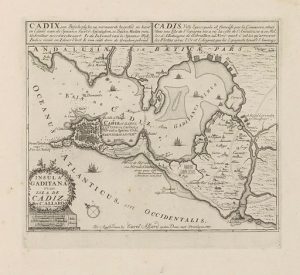
With its southerly latitude and Atlantic outlook, Cádiz is famed for its winter climate; early spring is likely to be very agreeable. The city stands on a peninsula jutting out into a bay, almost entirely surrounded by water.
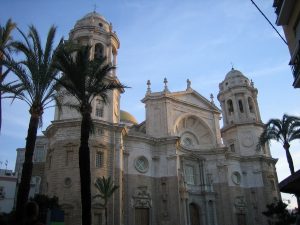
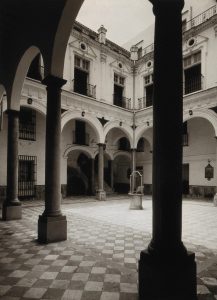
Named Gadir by the Phoenicians, who founded their trading post in 1100 BC, it was later controlled by the Carthaginians until it became a thriving Roman port. It sank into oblivion under the Visigoths and Moors, but attained great splendour in the early 16th century as a launching point for the journey to the newly discovered lands of America. The city was later raided by Sir Francis Drake in the struggle to gain control of trade with the New World, and managed to withstand a siege by Napoleon’s army. The course will be held in the historic (an understatement: no city in the western world has been occupied longer) centre, in the church of the Convento de las Reparadoras, Calle Zaragoza 14, 11003 Cádiz, very near Plaza San Antonio.
The course
Our plan will be to meet in time for supper on Sunday the 8th of March. Then from Monday to Friday our timetable will be a slight variation on the normal Lacock pattern to accommodate a daily mass at noon:
09.15 – 10.15 first session
10.15 – 10.45 break
10.45 – 11.45 second session
11.45 – 15.30 long break
15.30 – 17.00 third session
17.00 – 17.30 break
17.30 – 19.00 fourth session
We will arrange a supper for everyone together on the first and last evenings (not included in the fee for the course), but let the party split into smaller groups on the other four evenings. We’ll give a public performance in the evening of Friday the 13th of March.
Travel and accommodation
The nearest airport is Jerez, with flights from England with Ryanair, Tui and Vueling and elsewhere in Europe with Eurowings, Condor and Edelweiss.
There is a direct train from the airport to Cadiz and the journey takes just under an hour. Other possible airports are Seville and Gibraltar. From the excellent Man in seat 61 website you can find out how to reach Cádiz by train. You arrange your own accommodation. There is a wide choice of places to stay in the historic centre itself.
Fees and enrolment
The fee for the course is paid in two parts: a deposit of £365 (or the equivalent in euros) on registration and €350 on or before arrival in Cádiz. The deposit may be credited to another course if you have to withdraw and we are able to allocate your place to another singer. The fee includes payment for the music booklet, which will be sent to you in advance, but not meals, travel or accommodation.