Pierre de Manchicourt ~ Missa Cuidez vous
Anon (attrib. Thomas Crecquillon) ~ Sicut lilium inter spinas
Gheerkin de Hondt ~ Benedicite
Antoine Brumel ~ Magnificat sexti toni
Pierre de La Rue ~ Mater Maria gratiae, O salutaris hostia
The Illustre Lieve Vrouwe Broederschap (Confraternity of Our Illustrious Lady) in ’s-Hertogenbosch in the south of the Netherlands was an elite Marian brotherhood that became a vital centre for polyphonic music in the 16th century. The composers featured in this collection held direct professional ties to the institution; most notably, Gheerkin de Hondt served as the brotherhood’s sangmeester (choirmaster) from 1539 to 1547, and his festive Benedicite likely graced the confraternity’s banquets. Other composers like Pierre de La Rue and Thomas Crecquillon are well-represented in the brotherhood’s extensive music library. This rich repertoire reflects the sophisticated liturgical and social life of the brotherhood, which commissioned many of these masterpieces during the city’s musical golden age.
Patrick Allies writes: “The first part of the sixteenth century was a golden period for the musical life of the Marian Brotherhood in ’s-Hertogenbosch. Having built their own chapel within St John’s Cathedral, the brotherhood employed some of the leading singer-composers of the day (including Pierre de La Rue, Thomas Crecquillon and Clemens non Papa) to carry out polyphonic services there. The brotherhood furnished these liturgies with the finest sacred music money could buy, engaging none other than Petrus Alamire to supply them with manuscripts. This course will trace the brotherhood’s musical history and explore some of the riches of their collection, including an exquisite mass setting by the under-appreciated composer Pierre de Manchicourt.”
Patrick Allies
Patrick Allies is a conductor and musicologist based in London. He is a Visiting Artist and Researcher at King’s College London, Artistic Director of the vocal ensemble Siglo de Oro, and Musical Director of Imperial College Chamber Choir. After beginning his musical education as a chorister at the Temple Church, Patrick sang in Gloucester Cathedral Choir before taking up a choral scholarship to study music at King’s College London. Patrick went on to postgraduate study at the University of Cambridge. Patrick is a doctoral student in music at the University of Oxford. Patrick’s research, funded by the Arts and Humanities Research Council, involves the relationship between fifteenth-century choirs and their performance spaces.
Tenby
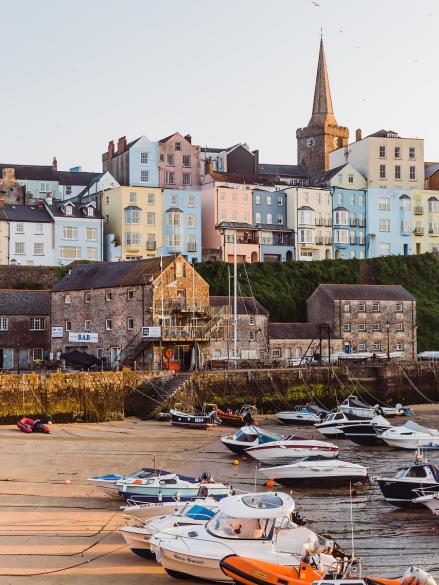
Tenby, a harbour town in Pembrokeshire is one of Wales’s lesser-known delights, with its 13th century town walls, picturesque houses, jumble of streets and several sandy beaches. The town has strong links with ’s-Hertogenbosch, which was liberated from Nazi occupation in October 1944 by the 53rd (Welsh) Infantry Division, an event still regularly commemorated in both Wales and the Netherlands. The prominent Tenby soldier Major John Kenric ‘Ken’ Evans (1918–2010) was one of the officers of the 4th Battalion of The Welch Regiment, which played a central role in freeing the city.
The ruins of Tenby Castle are on a headland overlooking the harbour. Exhibits at Tenby Museum and Art Gallery include the Tenby Gun, a nine-foot-long breech-loading Tudor cannon. The Tudor Merchant’s House recreates domestic life in 1500, with a merchant’s shop and working kitchen. There are excellent coastal walks right on the doorstep, including the Pembrokeshire Coastal Path.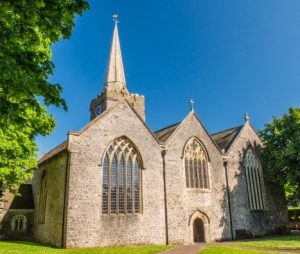
The course will be held in the town’s magnificent Grade I church, St Mary’s, which is in the centre of the town. Most of the building dates from the 15th century with some features from the 13th. The 13th century chancel has a wagon roof, and the panelled ceiling has 75 bosses carved in a variety of designs including foliage, grotesques, fish, a mermaid and a green man, as well as the figure of Jesus surrounded by the four Apostles. The tower also dates from the 13th century. Two chapels, the spire, the font and a bell cast with the name ‘Sancta Anna’ all date from the 15th century.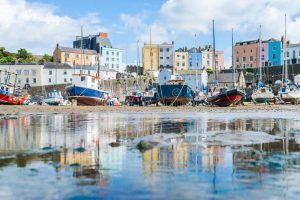
The course
Our aim is to convene a balanced ensemble of no more than 36 singers. Participants should have straight, blending voices with full dynamic range and be able to response quickly to direction. We will meet in the evening of Sunday the 20th of September for an opening rehearsal session. Then from Monday to Friday there will be sessions from 9.30am to 1pm and from 5pm to 7pm. On Friday the 25th of September we will give a public performance in the church, followed by a group dinner, which will mark the end of the course. Meals are not included in the fee for the course. All the music will be sent to you before the course, either printed in a booklet or as a pdf for you to read on a tablet.
Travel and accommodation
Tenby has a railway station on the Pembroke Dock branch of the West Wales Line operated by Transport for Wales Rail. The nearest airport is Cardiff. The M4 motorway and its continuation the A40 come within half an hour of the town. Tenby caters for a large number of summer visitors, so in September you can expect hotel and b&b accommodation will be easy to find.
Fees and enrolment
The fee for the course is £674, paid in two parts: a deposit of £337 (or the equivalent in euros) on registration and £337 by the end of August. The deposit may be credited to another course if you have to withdraw and we are able to allocate your place to another singer. The fee includes payment for the music booklet, which will be sent to you in advance, but not meals, travel or accommodation.