
Manuel Cardoso ~ Missa pro Defunctis, Non mortui
Filipe de Magalhães ~ Commissa mea pavesco
Pedro de Cristo ~ Parce mihi Domine
Antonio López Capillas ~ In horrore visionis nocturnae
Duarte Lobo ~ Audivi vocem de caelo
Alonso Lobo ~ Versa est in luctum
Musically as well as geographically, Portugal was on the periphery of Europe and the last place to adopt new musical fashions. The resulting combination of renaissance style and incipient baroque influences gives her music a special flavour and interest. Cardoso writes exquisite flowing polyphony in a highly individual style and to sing the six-Requiem is a deep musical experience. Other funerary motets by prominent Portuguese composers will make up our programme and we make no apologies for including the Spaniard Alonso Lobo’s perfect setting of Versa est – my harp is turned to mourning.
Patrick Craig is a countertenor and conductor. Since 2012 his regular Lacock courses, combining exploration of 16th and 17th century sacred music within its historical and cultural contexts, have been widely praised. 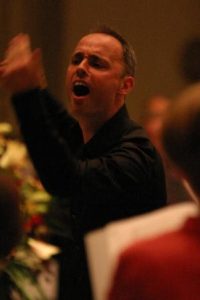 He is a Vicar Choral at St Paul’s Cathedral, a member of The Cardinall’s Musick and sang a thousand concerts around the world with the Tallis Scholars over a period of twenty years. He began conducting as organ scholar at Selwyn College, Cambridge, and then spent two years studying singing at the Royal College of Music. He went on to found and direct Aurora Nova, the first all-female professional choir to lead Sunday worship at St Paul’s Cathedral. He led them on their first tour of USA, and also conducted the City of London Sinfonia in a series of orchestral Masses at St Paul’s. Other conducting opportunities followed including guest conducting The Cardinall’s Musick at the Brinkburn, Brighton, Lichfield and Aldeburgh Festivals. He is also the Director of Temenos chamber choir in Sevenoaks, with whom he has conducted Bach’s Magnificat and B minor Mass and Handel’s Dixit Dominus. In 2019 Patrick conducted his first Messiah in the Lichfield Festival, Biber’s 53-part Missa Salisburgensis in Thaxted, and made his conducting debut in Hong Kong.
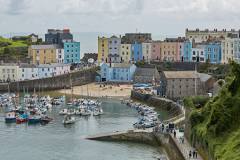
Tenby
Tenby, a harbour town in Pembrokeshire is one of Wales’s lesser-known delights, with its 13th century town walls, picturesque houses, jumble of streets and several sandy beaches.
Its links with Portugal go back at least to the 16th century when, as the town’s web site proudly records, “Tenby’s importance increased as trade with Europe flourished in late medieval times, and in 1566 Portuguese seamen landed the first oranges to be brought to Wales at Tenby harbour”. The ruins of Tenby Castle are on a headland overlooking the harbour. Exhibits at Tenby Museum and Art Gallery include the Tenby Gun, a nine-foot-long breech-loading Tudor cannon. The Tudor Merchant’s House recreates domestic life in 1500, with a merchant’s shop and working kitchen. There are excellent coastal walks right on the doorstep, including the Pembrokeshire Coastal Path.
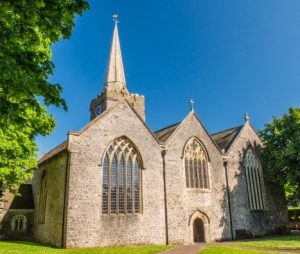
The course will be held in the town’s magnificent Grade I church, St Mary’s, which is in the centre of the town. Most of the building dates from the 15th century with some features from the 13th. The 13th century chancel has a wagon roof and the panelled ceiling has 75 bosses carved in a variety of designs including foliage, grotesques, fish, a mermaid and a green man, as well as the figure of Jesus surrounded by the four Apostles. The tower also dates from the 13th century. Two chapels, the spire, the font and a bell cast with the name ‘Sancta Anna’ all date from the 15th century.
The course
Our plan will be to meet at a restaurant for an opening dinner at 7.30 on Sunday the 27th of April. Then from Monday to Friday our timetable will be:
9.30 – 11.00 first session
11.00 – 11.30 break
11.30 – 13.00 second session
13.00 – 17.00 long break
17.00 – 19.00 third session
We will arrange a dinnerfor everyone together on the last evening (not included in the fee for the course), but let the party split into smaller groups on the other evenings. We’ll give a public performance in the evening of Friday the 2nd of May.
Travel and accommodation
Tenby has a railway station on the Pembroke Dock branch of the West Wales Line operated by Transport for Wales Rail. The nearest airport is Cardiff. The M4 motorway and its continuation the A40 come within half an hour of the town. Tenby caters for a large number of summer visitors, so in May you can expect hotel and b&b accommodation will be easy to find.
Fees and enrolment
The fee for the course is £650, paid in two parts: a deposit of £325 (or the equivalent in euros) on registration and £325 by the end of March. The deposit may be credited to another course if you have to withdraw and we are able to allocate your place to another singer. The fee includes payment for the music booklet, which will be sent to you in advance, but not meals, travel or accommodation.