August: This newsletter brings you news that our three summer 2025 courses are now published at www.lacock.org, though bear in mind that Lucy and I are shortly off to Trogir and won’t be able to respond to any applications for over a week. Lacock courses are generally fully subscribed but the odd free place appears from time to time, so it’s always worth asking about events that have already been announced. For instance, another tenor or baritone would be warmly welcomed on Rory McCleery’s Josquin week in the south of France at the end of this September.
JanJoost van Elburg will lead the invited Monteconero Music Party from the 1st to the 7th of June in a programme combining demanding music from both ends of the polyphonic era – works by John Browne and Walter Lambe from the Eton Choirbook, with Gesualdo’s Tenebrae Responsories. There is always competition for places on JanJoost’s weeks, but let us know if you think you would fit in but are not usually on the guest list.
This will be followed by a second Monteconero week, from the 8th to the 14th of June, in which Rory McCleery will direct some of the greatest monuments of Spanish polyphony, several for eight voices, by Morales, Guerrero, Lobo and Victoria. Rory is hugely enthusiastic about this repertoire – and also his first visit to Monteconero – and the week promises to be a real feast, musically as well as gastronomically.
Back in England we will return to Skipton in the Yorkshire Dales from the 6th to the 11th of July for a week with Bill Carslake based on the Baldwin Partbooks, a remarkable set of manuscript copies of the repertoire he was singing in St George’s Chapel Windsor and the Chapel Royal made by a young singer named John Baldwin. It is now one of the most important sources of Tudor church music dating back to before the Reformation. Our selection includes music by Sheppard, White, Mundy, Tallis, Byrd and Parsons.
We are still working on details of the rest of 2025, but in outline they will include a week in the Suffolk town of Woodbridge from the 31st of August to the 5th of September in which Eamonn Dougan will direct a programme of music in honour of the Virgin Mary. Then Patrick Craig will lead a course centred on Tallis’s Spem in alium in Gourdon-en-Quercy in SW France, from the 21st to the 26th of September, to commemorate our fortieth year. It will be for invited voices singing one to a part. We end the year with Gabriel Crouch, we hope in Rome, from the 19th to the 24th of October, depending on the progress of roof repairs to the English church.
We leave the summer with some good memories. Lucy Goddard did a brilliant job in her Song of Songs programme at Monteconero and we will surely be trying to get her to lead another course very shortly. It was good to make our first visit to Ludlow since covid. Some of the music – Ludford, Taverner and Fayrfax with Rory Wainwright Johnston – has an ecstatic quality that is hard to equal. One not so good memory is random customs delays to music booklets sent abroad, especially to Scandinavia. We now always can offer the booklet as pdfs, so anyone equipped to read from a tablet is encouraged to do so.
One singer who sadly will not be with us in Trogir is Sally Morris, who died unexpectedly from pneumonia earlier this year. Among other things she was a very dependable alto with a rich tone and faultless sightreading. One always knew a section would have no problems if Sally was part of it. She was a good example of what the Italians would call simpatica, and always quietly helpful to any colleague who didn’t quite match her musical distinction. As she reminded me many years afterwards when she started coming to Lacock courses, we had first met back in the 70s. As the youngest member and general gopher of the Early Music Consort, I had had to take some material for the book Instruments of the Middle Ages and Renaissance to the London offices of the Oxford University Press; Sally was the copy editor who received it. She will be much missed.
I was sorry also to hear of the death of Nigel Perrin. I had met him too in the 70s when I played on a recording of the Kings Singers; we were reintroduced by a friend when I moved to Lacock and he was living in Bath. I asked him to direct a lot of Lacock courses in those early days. Once when we were in La Maison Verte in the south of France a colleague from the film world somehow tracked me down on the phone (this was before mobiles) and asked if I could suggest a countertenor who could act. I said there was one standing beside me. That led to Nigel’s prominent role of Apollo in The Clandestine Marriage with Timothy Spall, Nigel Hawthorn and Joan Collins. I took a decidedly minor part of a serpent player in the ballroom band. Nigel had boyish looks, a certain charisma and a strong cult following among the choirs he conducted. His groupies liked to call themselves ‘The Perrinettes’, but in our household they were usually referred to as ‘The Wives of Bath’.
Happily still with us but recently deciding that the time is right to bow out from courses after a lifetime of singing, is someone many of you will know, Robert Mitchell. As a young singer in London he saw that Sir Malcolm Sargent – Flash Harry as he was universally known – was to conduct a performance of Messiah at the Proms. It was a work that Bob knew well and he thought he would quite like to take part. Noticing that three choral societies had combined to muster the forces (those were the days!), he figured that an extra strange face in the green room wouldn’t give rise to any suspicion. On the evening of the performance, having attended none of the rehearsals, he donned a dinner jacket and with shoulders back and a score under his arm, strode through the stage door of the Royal Albert Hall. He made sure he was the last into the choir seats and asked the end bass to move up, muttering something about having had to miss the dress rehearsal. He went on to lead a blameless life as a tax inspector with Her Majesty’s Revenue and Customs.
Andrew Parrott’s Taverner Choir is fifty years old this year. To mark the occasion, some friends and colleagues organised a Festschrift or liber amicorum – I don’t know why there isn’t an English word for it. The book is entitled The Essential Andrew Parrott in honour of Andrew’s seminal book The Essential Bach Choir and it was presented to Andrew, who has led Lacock courses in Oxford, Florence and Trogir, at an event in Oxford this February. I have put my contribution on the web site in the ‘Lacock people’ pages.
May: This newsletter brings you news of three new courses at the beginning of 2025. Do let us know as soon as you are able if you are interested in coming to any of these courses; these days the courses are in general oversubscribed and we take great trouble to assemble groups of matching voices and it’s frustrating to have to turn away an applicant who would have fitted in very well after all the places have been allocated.
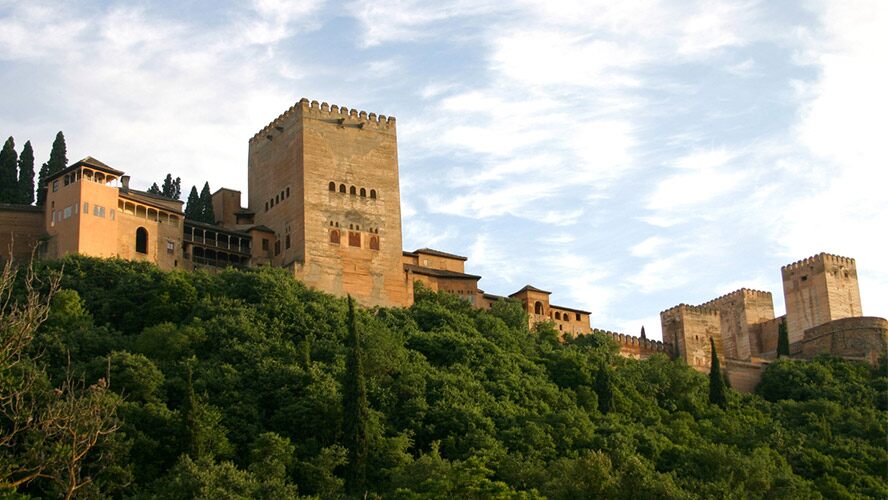
The first course of 2025 will be a return to Granada from the 2nd to the 7th of March, when Gabriel Díaz will lead a course devoted to the first great Spanish composer – and near contemporary of Thomas Tallis – Cristóbal de Morales. The main work will be his mass Mille regretz, based on the Josquin chanson. It takes an exceptional venue to draw us back in successive years, and our monastery in the mediaeval quarter, the Albaicín literally in the shadow of the Alhambra proved impossible to drag ourselves away from.
From the 31st of March to the 5th of April we go to Swanage with Rory Wainwright Johnston. There is a lot about seaside places that makes them very suitable venues for courses. Out of season there is no difficulty finding places to stay and to eat, there is a lot to do and to see and a constant bustle, all set against the drama of the tides. They often prospered as ports in the Middle Ages and have grand churches to show for it. For the repertoire we return to the Low Countries of Josquin’s brilliant generation and in particular their exploration of increasingly complex polyphony. The central work will be Jacob Obrecht’s Missa Sub tuum praesidium, which begins with a three-part Kyrie, gradually adding voices and ending with a seven-part Agnus. This week will be by invitation, but do let us know if it particularly interests you.
Tenby in Pembrokeshire is another ancient port which has us hooked. Patrick Craig will lead ‘A Portuguese Requiem’ from the 27th of April to the 2nd of May. The central work will be the six-part Requiem of Manuel Cardoso, into which we will interleave funerary motets by other Portuguese composers and the sublime Versa est in luctum of Alonso Lobo – yes, not Portuguese but widely performed throughout Iberia and indeed Mexico in his day.
Plans for the rest of 2025 are taking shape. They will include two weeks at Monteconero, in the first of which, from the 1st to the 7th of June, JanJoost van Elburg will direct a programme combining music from the Eton Choirbook with the Gesualdo Lamentations. The second week – we hope to be able to announce the programme soon – will be from the 8th to the 14th of June. There will be the usual four more course after these, and as it will be our 40th year, they will include a week including Tallis’s Spem in alium with Patrick Craig in the very suitable mediaeval church of Les Cordeliers in Gourdon-en-Quercy in the Lot in southwest France. This will take place from the 21st to the 26th of September.
The current year has begun in fine form. In March we were in Granada with Gabriel Díaz singing the Pedro Ruimonte Lamentations, a new discovery for most of us. Our rehearsal space couldn’t have been more apt, the coro alto, or raised choir room at the rear of our monastery church, with just enough choir stalls around three sides to seat the whole group. Then in April to Lyme Regis, another seaside discovery for a Portuguese week with Patrick Craig. It included two marvellous pieces by Vincente Lusitano, a composer of partly African descent. We’ll certainly find an early opportunity to discover more of his music. Most recently to Tenby, where we were lucky enough to persuade Lionel Meunier to lead a workshop exploring some of the choral techniques practised with such success by his group Vox Luminis.
Lionel’s extraordinary rise to fame in recent years has put great demands on his time, and I found that the only reliable way to communicate with him was to go to one of the frequent concerts of Vox Luminis at the Wigmore Hall and doorstep him after the performance. Of course to buy Wigmore tickets you now have to register all your details, and they ask you to choose from a laughably complete list of possible titles, which here in egalitarian Lacock we dispense with entirely. Fascinated by this glimpse into a now largely disappeared world, I thought I’d try a few to see how they looked, only to discover that once checked the boxes couldn’t be unchecked. My communications from the Wigmore Hall now all begin ‘Dear Maestro Andrew van der Beek, Esquire’.
We are very happy that there are now plenty of good singers on our books and the courses are usually fully subscribed. But people inevitably have to drop out of a course for one reason or another, so it’s always worth asking if you think of joining a course at short notice. In this year’s programme Lucy Goddard’s Song of Songs week at Monteconero in June, early Tudor music with Rory Wainwright Johnston in Ludlow in July, and Josquin and his school with Rory McCleery in late September all with the odd late vacancy.
With the number of excellent singers now coming to Lacock courses from the Nordic countries, I was pleased to receive as a Christmas present The Northern Silence: Journeys in Nordic Music and Culture by Andrew Mellor. It is a wide-ranging look the cultural psyche of the region that had become a musical powerhouse, not brushing aside the darker side of the Scandinavian Utopia and the twilight of the social democratic dream. Andrew was a Lacock scholar back in the nineties, when as a schoolboy he took the role of a sailor in Purcell’s Dido and Aeneas. The event was not one of Lacock’s high points: in the role of Dido we’d cast an insufferable prima donna, who caused growing alarm by refusing to come to any rehearsal until the run-through on the morning of the performance. This of course was a fiasco. Over lunch I had to negotiate extra rehearsal by shuttle diplomacy between the diva and the conductor, who by this stage were no longer talking to each other. It was the only recorded performance of the work in which a murmur of satisfaction went round the chorus when Dido finally expired.
January: It’s traditional on this date to wish you a Happy New Year, but at the moment the portents don’t look at all promising. Perhaps we should just settle for the solace of music to take our minds off the ghastly things happening in so many parts of the world.
In July (the 14th to the 19th) we make our first post-covid return to Ludlow, a gem of a small town near the Welsh border, with its cathedral-like church of St Laurence in which the course will be held. The centrepiece of the repertoire will be Nicholas Ludford’s magnificent six-part Mass Videte miraculum, the only English mass with divided treble line until that of Vaughan Williams. Rory Wainwright Johnston will direct: “It will be an absolute pleasure to return to lead this course in Ludlow, with some of my favourite pieces from the early English repertory, as well as some ‘miracles’ for which the chance and time rarely arises to dig deep into their beautiful melodies and enticing part writing.”
Then in early September (the 2nd to the 8th) we head back to the Dalmatian coast for the Trogir Music Party with JanJoost van Elburg. This invited course will combine early music by Palestrina and Gombert with contemporary pieces by James MacMillan, Urmas Sisask and Arvo Pärt. We have again been invited to sing a mass (Palestrina’s Missa Fratres ego) in the cathedral on Sunday morning and during the week will take a short boat trip to sing in Diocletian’s palace in Split.
At the end of the month (the 22nd to the 27th) we will continue our ‘Polyphonies franco-flamandes’ in the town of Gourdon in the Lot in southwest France. Rory McCleery has devised another programme which celebrates the music of Josquin des Prez and the wonderful flourishing of French music around 1500. The town has given us a splendid gothic church with a vaulted stone ceiling, now deconsecrated and used as an arts centre. Our concert last summer was greatly appreciated by locals, who came to listen in large numbers. Gourdon is one of those mediaeval hill towns that dot la France profonde. You can drive there from the channel ports in a day and it has a railway station on the line from Paris to Toulouse.
Our year will end once again in another of our very happy recent discoveries, the town of Dartmouth in south Devon. Eamonn Dougan’s programme (from the 13th to the 18th of October) explores the music of the imperial Habsburg court in Vienna. Lassus visited from Munich and was astonished at the quality of music-making there. Philippe de Monte remains well-known but this course will be a chance to reassess his worthy but largely forgotten contemporaries such as Jacobus Vaet, Alexander Utendal and Jacob Regnart.
These courses make the year complete. The full programme is:
March: Granada, Pedro de Ruimonte Lamentations with Gabriel Díaz
April: Lyme Regis, Portuguese music with Patrick Craig
May: Tenby, invited course with Lionel Meunier
June: Monteconero, music in seven parts with Patrick Craig, followed by Song of Songs with Lucy Goddard
July: Ludlow, early Tudor music with Rory Wainwright Johnston
September: Trogir, Palestrina and others with JanJoost van Elburg, followed by
Gourdon en Quercy, more Josquin & Co. with Rory McCleery
October: Dartmouth, de Monte, Vaet and Utendal with Eamonn Dougan
All the details, including the exact dates are on the Lacock web site. Note that the web page for each course has two tabs, one with details of repertoire and director and the other with more mundane practicalities including fees – you just need to click on the second tab to see these. Most of the previously announced courses early in the year are now full, but there is the odd place available and inevitably people have to withdraw from time to time for one reason or another, so it’s always worth asking if you’re tempted to join any of these courses but haven’t yet applied.
Since I last wrote we had a memorable week in Trogir with Patrick Craig, with the climax a concert in the cathedral. In true Mediterranean style the promised lighting arrived one minute before we were due to perform. One afternoon we took the ferry to Split and had a session in the cathedral there. It was begun in the 3rd century and first served as Diocletian’s mausoleum – that makes the 11th century bell tower feel quite modern. Earlier in the year I had to arrange a meeting with Patrick and Vinko Buble, our very useful contact in Trogir, who was visiting London. I thought it would suit Patrick to meet near St Paul’s after a service in which he was singing. I wrote them both a text suggesting a meeting after the cathedral Eucharist. Luckily I checked it before pressing send – the auto correct had changed ‘Eucharist’ to ‘witchcraft’.
We ended the year with a week in Dartmouth with Bill Carslake. The centrepiece of the repertoire was Cipriano’s Praeter rerum Mass, with divided and very energetic bass parts. It’s rare for basses to be given such a starring role and my colleagues and I rose to the occasion (so I’m told). On the Saturday morning I managed to get Bill to Exeter station for his 8.26am train to Holyhead and then on to County Mayo in Ireland where he now lives, very grateful to Google Maps for navigating us through the Devon lanes harried by rain, darkness and nicotine-crazed commuters. Then on to London, passing not far from my old Lacock home. I stopped just after Stonehenge and asked for an espresso with a little extra water. “Espresso doesn’t have water in it” was the baffling reply. Very Wiltshire.